


A separate chauffeur license is not required everywhere to drive a limousine. The rules depend on the state, vehicle, passenger count, and whether you drive for hire.
Do You Need a Chauffeur License to Drive a Limo? In many places, you need a valid driver’s license plus extra commercial or passenger-carrier requirements. In Colorado, passenger-carrier drivers must be at least 21, hold a valid driver’s license, meet medical standards, and pass required driving-history and background checks.
Do You Need a Chauffeur License to Drive a Limo?
There is no single chauffeur license rule for every limousine driver in the United States.
Some states use the term “chauffeur license.” Others use a commercial driver’s license, passenger endorsement, permit, certificate, or other driver qualification.
The rules can also change based on how the limousine is used.
Driving your own limousine for personal trips is different from carrying paying passengers. A limousine company may also have separate licensing, insurance, vehicle, and operating requirements.
For example, Colorado treats luxury limousines as limited-regulation passenger carriers. A company that provides passenger transportation for compensation may need authority from the Colorado Public Utilities Commission.
This means you should check both:
- Driver requirements
- Vehicle requirements
- Company requirements
- Insurance rules
- Passenger limits
- Local transportation rules
Do not assume that a regular driver’s license answers every licensing question.
What License Do You Need to Drive a Limo?
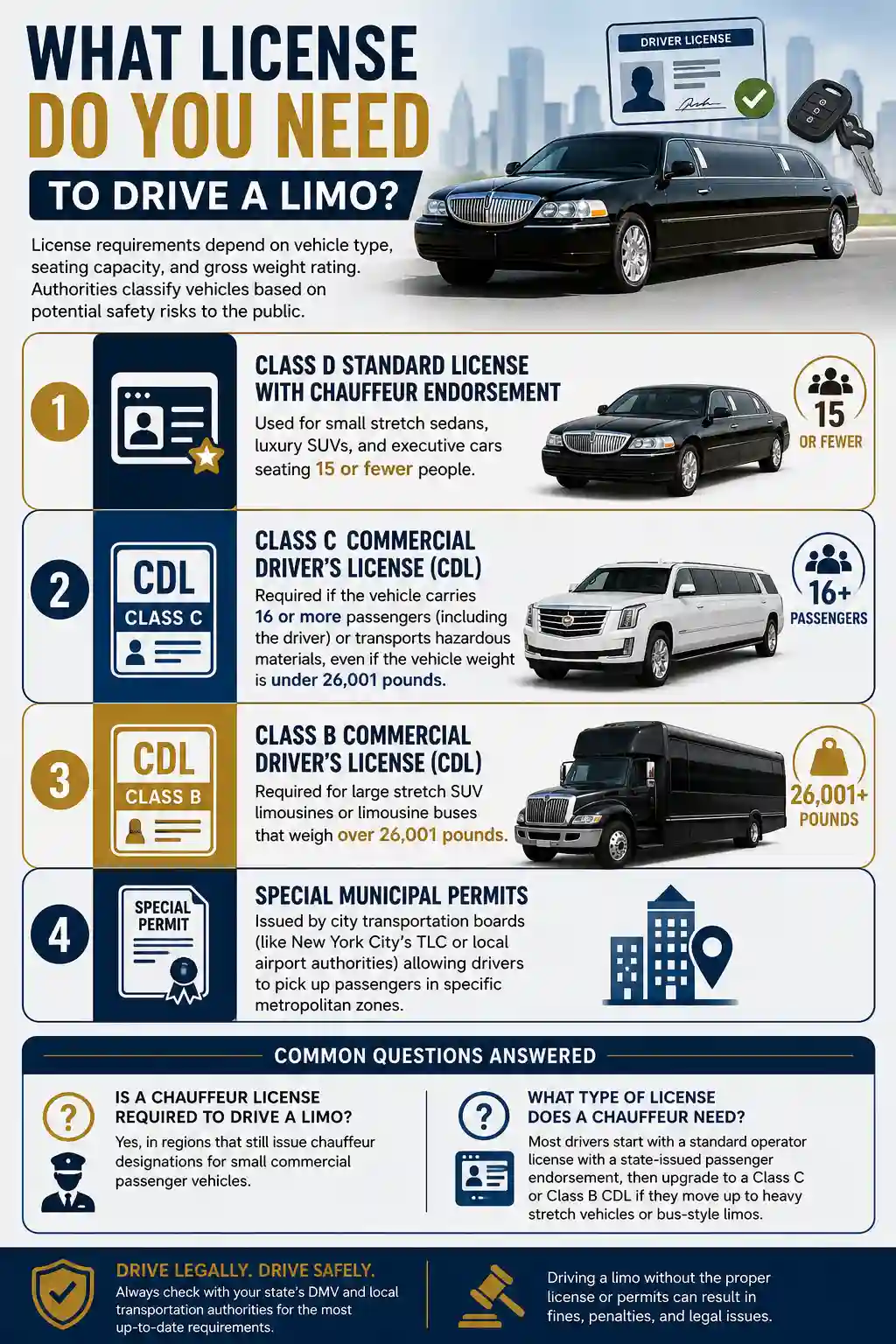
The license you need depends on the state and the limousine you operate.
For some smaller limousine-style vehicles, a standard driver’s license may be enough for the basic vehicle class. However, operating the vehicle commercially can create additional requirements.
A state may require:
- A regular driver’s license
- A chauffeur license
- A commercial driver’s license
- A passenger endorsement
- A passenger transportation certificate
- A local permit
- A medical certification
- A background check
- A clean or acceptable driving record
These requirements are not interchangeable.
For example, a passenger endorsement is different from simply having permission to drive a larger vehicle. California requires certain passenger transport drivers to have an appropriate certificate or endorsement in addition to the correct driver license.
Before starting work, check the rules for the state where the limousine service operates.
Can You Drive a Limo With a Regular License?
Sometimes, but not always.
The answer depends on the vehicle and how you use it.
If the limousine falls within the limits of your normal driver’s license, you may not need a CDL simply because the vehicle looks like a limousine.
Commercial passenger transportation can still create separate requirements.
This is an important distinction.
A person driving a limousine owned by a friend for a private event may face different rules from a person driving that same vehicle for a limousine company.
The vehicle’s seating capacity also matters. A large passenger vehicle may fall under different license requirements than a smaller sedan-style limousine.
Do You Need a CDL to Drive a Limousine?
A CDL is not automatically required just because you drive a limousine.
CDL requirements usually depend on the vehicle’s class, weight, passenger capacity, and other factors set by federal and state law.
A limousine that falls within ordinary passenger-vehicle limits may not require a CDL. A larger vehicle that meets the legal definition of a commercial motor vehicle may require a different license or passenger endorsement.
The safest approach is to check the vehicle’s specifications before assuming a CDL is needed.
Look at:
- Gross vehicle weight rating
- Number of seats
- Vehicle type
- State requirements
- Whether passengers pay for transportation
- Whether the vehicle crosses state lines
Do not confuse a chauffeur license with a CDL. They can refer to different legal requirements.
Chauffeur License vs. Regular Driver’s License
A regular driver’s license generally allows you to operate personal vehicles within the limits of that license.
A chauffeur or commercial passenger credential may involve extra requirements because you are transporting people as part of your work.
Those requirements can include:
- Driving record checks
- Medical standards
- Background checks
- Special testing
- Passenger safety rules
- Commercial insurance
- Employer record checks
Colorado provides a good example. Its passenger-carrier rules require a driver to be at least 21, hold a valid driver’s license, meet medical qualifications, and avoid disqualifying results from driving-record and criminal-history checks. The carrier must also review the driver’s history before allowing the person to operate as a driver.
So, the question is not only, “Can I legally drive this vehicle?”
You also need to ask, “Can I legally drive this vehicle while transporting passengers for compensation?”
Does Passenger Capacity Affect Limo Licensing?
Yes. Passenger capacity can affect the license and rules that apply.
A small stretch limousine may fall under different rules than a large passenger vehicle.
The driver’s required license can depend on the number of passengers the vehicle is designed to carry, including the driver.
Vehicle weight can also matter.
This is why limousine operators should check the manufacturer’s seating information and vehicle weight rating before hiring or assigning a driver.
In California, for example, a bus is defined under state rules partly by passenger capacity. A vehicle designed for more than 15 people including the driver can fall under the bus definition, while certain vehicles designed for more than 10 people and used for compensation can also meet the definition.
The exact rules differ by state, so never use another state’s passenger limits as your own legal standard.
Do You Need a Special License to Drive a Limo?
Not always.The phrase “special license” can cause confusion because states use different terms.
One state may call it a chauffeur license. Another may require a passenger endorsement. Another may regulate the company rather than issue a separate chauffeur credential.
The vehicle itself can also change the answer.
For example, a standard sedan used privately may be treated differently from a limousine used to transport customers for payment.
If you plan to work as a professional chauffeur, ask your state licensing agency and the transportation regulator about both driver and carrier requirements.
That is more reliable than relying on a generic national rule.
Can I Drive a Limo for Personal Use?
In many cases, yes, if you meet the licensing and vehicle requirements that apply to that vehicle.
The key issue is how the vehicle is classified and used.
If you are simply driving family or friends without payment, you are not operating the same type of commercial service as a paid chauffeur.
Still, passenger capacity and vehicle size can affect the license required.
You should also confirm that your insurance policy allows the intended use.
Personal auto insurance and commercial limousine insurance are not the same thing. If you later start accepting paid rides, your insurance needs can change.
Do You Need a Special License to Drive a Limo for Personal Use?
The answer depends on the vehicle rather than the word “limousine.”
If you own a limousine and use it only for personal transportation, commercial passenger-carrier rules may not apply in the same way.
For example, you might use a limousine to attend a wedding, family event, or private party without charging passengers.
That is different from accepting payment to transport customers.
However, personal use does not automatically remove every requirement.
The vehicle still needs to meet registration, insurance, safety, and driver’s license rules that apply in your state.
Check your local requirements before purchasing or driving a large limousine.
What Are the Requirements to Become a Limo Driver?
The exact requirements vary by state and employer.
However, professional limousine drivers are commonly expected to meet several basic standards.
Valid Driver’s License
You need a current license that legally covers the vehicle you drive.
Minimum Age
Some passenger-carrier rules set a higher minimum age than ordinary driving.
Colorado’s passenger-carrier rules, for example, require covered drivers to be at least 21.
Driving Record
A limousine company may review your driving history before hiring you.
Colorado rules require passenger carriers to obtain and review a driver’s motor vehicle history before allowing the person to act as a driver and at least once every 12 months afterward.
Medical Qualification
Some commercial passenger operations require medical qualification.
This helps confirm that drivers can safely perform their duties.
Background Check
Passenger transportation businesses may also have background-check requirements.
These checks help companies meet safety standards and protect passengers.
Customer Service Skills
Legal requirements are only one part of being a good chauffeur.
Professional drivers should also know how to:
- Communicate clearly
- Handle luggage carefully
- Follow pickup instructions
- Drive smoothly
- Maintain privacy
- Arrive on time
- Treat passengers respectfully
How Do You Get Licensed to Drive a Limo?
Start by identifying the state and city where you will work.
Then check the requirements for:
- Driver licensing
- Passenger transportation
- Commercial vehicle rules
- Insurance
- Background checks
- Medical certification
- Passenger endorsements
- Local permits
If a CDL is required, you may need additional training and testing.
If a chauffeur or passenger certificate is required, follow the state’s application process.
Do not pay for a private course until you know which credential your state actually requires.
Some courses advertise “chauffeur licensing” even when the state does not use that exact license.
Do Limo License Requirements Vary by State?
Yes. This is one of the most important points to understand.
There is no single national chauffeur license that covers every limousine driver.
Each state can establish its own rules for passenger transportation.
Local authorities can also have additional requirements.
For example, California requires certain passenger transportation drivers to hold a certificate or endorsement in addition to the appropriate driver license.
Colorado takes a different approach. The Colorado Public Utilities Commission regulates for-hire passenger carriers, including luxury limousine services, and its rules establish driver qualification requirements.
That difference shows why online articles should not give one answer for every state.
If you are starting a limousine business, verify the current rules with your state transportation and licensing agencies.
What to Look for in a Professional Limo Service
If you are hiring a limousine, ask more than just, “How much does it cost?”
A reliable company should be able to explain its service, vehicle, and driver standards clearly.
Look for:
- Properly licensed drivers
- Appropriate commercial insurance
- Well-maintained vehicles
- Clean interiors
- Clear pricing
- Professional communication
- On-time pickup practices
- Safe driving standards
- Clear cancellation terms
You can also ask whether the company verifies driver records and keeps required vehicle inspections current.
For travelers choosing Denver Concierge Limo, these questions can help you understand what you are paying for and what type of service you should expect.
Conclusion
Do You Need a Chauffeur License to Drive a Limo? There is no single answer for every driver. Some states require a special chauffeur credential, while others use passenger endorsements, commercial licenses, or carrier rules.
The vehicle’s size, passenger capacity, and intended use all matter. Driving a limousine for personal use can also involve different rules than transporting paying customers.
If you are hiring a chauffeur, choose a company that takes licensing, safety, vehicle care, and passenger service seriously. If you are considering professional transportation in Denver, Denver Concierge Limo can help you choose a suitable chauffeur service for airport trips, business travel, events, and private transportation.
Frequently Asked Questions
Do you need a chauffeur license to drive a limo?
Not necessarily. Requirements depend on the state, vehicle, passenger capacity, and whether you transport passengers for payment.
Can you drive a limousine with a regular license?
You may be able to drive some limousines with a regular license if the vehicle falls within that license’s limits. Commercial passenger rules may still require additional credentials.
Can you drive a limo for personal use?
Yes, you may be able to drive a limousine for personal use if you meet the applicable vehicle and driver licensing rules. Personal use can be treated differently from paid passenger transportation.
Do you need a CDL to drive a limousine?
Not automatically. A CDL requirement depends on factors such as vehicle class, weight, passenger capacity, and state law. Do not assume every limousine requires a CDL.
Do you need a special license to drive a limousine for personal use?
Not always. The answer depends on the vehicle and state. Personal use may avoid some commercial passenger requirements, but normal driver licensing, registration, and insurance rules still apply.